
The following is an excerpt from “Their Last Alarm: Honouring Ontario’s Firefighters” by Robert B. Kirkpatrick.
May 17, 1947 – Toronto Fire Dept.
At around 1 a.m. on the morning of May 17, 1947, a passing pedestrian noticed a fire inside the Queen Alexandra Public School at 181 Broadview Avenue in the east end of Toronto and pulled the fire alarm box nearby. Vandals had broken into the school, ransacked it, and set a fire.
At 1:05, Box 248 brought out Pumpers 12 and 7, Aerial 7, and District Chief Dave Maxwell, who found heavy smoke and fire coming from two classrooms on the upper level of the school. The chief was confronted with a serious fire in a large building and quickly called the second of an eventual three alarms.
At Fire Station 5 on Lombard Street, the pumper crew got up and dressed when the first alarm went out and were ready when the second alarm signal came in at 1:14, which also brought out Pumper 4 from the Berkeley Street station. Pumper 5 driver Ralph Brunton, along with Captain Alex Johnston, and with firefighters Albert Creighton and Melville Kerfoot on the tailboard, left the Lombard Hall and went up Jarvis Street to Queen Street. They intended to go east along Queen to Broadview and then north to the school.
The truck from the Berkeley station, which was closer to the school, left seconds later. Pumper 4 driver John Morrison and Captain Jesse Stroud, with firefighters Joseph Walker and Charles Leslie on the tailboard, left the Berkeley Street Hall and proceeded north on Parliament Street. Pumper 4 intended to go up Parliament to Dundas Street and across to Broadview instead of turning east on Queen Street.
Traffic was light at that time of night, but Pumper 5, coming across Queen Street, was delayed a little as they had a red stoplight at Sherbourne Street. The heavy truck gathered speed as it approached a green light at Parliament. Constable David Peacock was walking his beat about ten doors west of Parliament when he heard eastbound Pumper 5 approaching. He flagged two cars on Queen Street to the curb and started off to the intersection to alert any traffic. As this is a downtown area with buildings close to the road, he didn’t see or hear the northbound pumper approaching. Before he could get there, Pumper 4 entered the intersection. Both drivers tried to avoid collision, but it was too late.
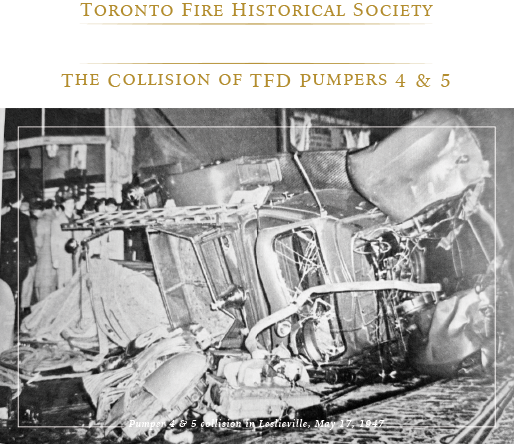
At 1:16 a.m., the Berkeley pumper was t-boned by the Lombard pumper with a horrendously loud crash. The sound of impact was described as louder than a cannon, and people started running from four blocks away. Northbound Pumper 4, which was hit in the hose bed area, was sent up Parliament Street in a wild arc, broke off the traffic light post, and came to rest against the Bank of Toronto, facing south, on the northeast side of Parliament. Eastbound Pumper 5 had its engine and front end torn off, rolled over several times, and landed on its side about thirty feet east of the intersection on Queen, in front of the bank. Fire equipment and hose were strewn all over the intersection, and some of it crashed through the bank’s plate glass window.
Every firefighter had been thrown. Driver Ralph Brunton of Pumper 5 flew over the windshield of the open-cab truck, hit a lamp post, and landed on the south side of Queen Street. Captain Alex Johnston was thrown clear and landed on the sidewalk with a gash above the eye. Firefighters Creighton and Kerfoot were thrown through the air and landed unconscious on the road. Pumper 4 driver John Morrison and Captain Jesse Stroud were also thrown from their truck but suffered minor injuries. Walker and Leslie went through the air with hose and nozzles and landed against the bank. One was killed instantly, and the other shouted for an ambulance before succumbing to his injuries.
Citizens in the area came out to give what aid they could and call for help. Using two ambulances, a police patrol wagon, and commandeered automobiles, the injured were taken to St. Michael’s Hospital. The hospital also had to deal with several injured from another fatal accident, between a TTC work truck and a car on Broadview Avenue, ten minutes before the fire truck crash.
Melville Kerfoot died in hospital from his injuries at 10:10 that morning. Albert Creighton had a fractured skull and severe internal injuries and, although expected to die, made a miraculous recovery.
Charles “Bud” Leslie Jr. was twenty-five, married, and joined the TFD on July 13, 1945, as a temporary firefighter after serving Canada overseas for five years in the Second World War. He became permanent on May 8, 1946. His father, also a member of the TFD, had died earlier in the week from a stroke.
Joseph Walker was twenty-six, single, and was a new recruit, having joined on April 15, 1946, after serving four years in the navy.
Melville Kerfoot was forty-two, married, and had three children. He was a veteran member of the department, having joined on April 1, 1929, and was the popular catcher on the firefighters’ softball team. One of his sons, Donald, who was thirteen when his father died, joined the TFD on December 3, 1954, and retired in the 1980s.
The funeral for all three Toronto firefighters was held on Tuesday, May 20, at St. David’s Anglican Church on Donlands Avenue. The large cortège of firefighters from across Ontario and Quebec marched behind standard hearses in the bright spring sunshine to Danforth and Coxwell Avenues, where the procession split up to go to separate cemeteries. Thousands of citizens lined the route to pay their respects. Fire department honour guards took part in the burial services for Charles Leslie Jr. at Pine Hill Cemetery, for Melville Kerfoot at Westminster Cemetery, and for Joseph Walker at St. John’s Cemetery. Not since 1934 had three Toronto firefighters been killed together.
When asked what happened that night, Captain Alex Johnston said, “It was just one of those things.”
On June 1, 1947, an old provision of the Municipal Act giving municipalities the right to pass bylaws for absolute right-of-way to fire apparatus was repealed. Since that day, responding fire apparatus are under the traffic laws of the Highway Traffic Act and must stop at all red lights before proceeding.
The intersection of Queen and Parliament hasn’t changed much since 1947. A restaurant occupies the bank, and a wooden hydro pole still stands on the corner. In 1989, ten lives were lost in a hotel fire across the street.